Background: When I joined BA, the UX function was, in practical terms, nonexistent. A single internal resource supported the entire organization while two external agencies absorbed the bulk of the design work — operating largely in isolation from one another and from the product and technology teams they were meant to serve. There was no shared language for how design work got started, no structure for how it was evaluated, and no mechanism for ensuring that what shipped actually reflected user needs. Design was reactive by default: requests arrived informally, work began without sufficient context, and the absence of a feedback loop meant the same problems resurfaced sprint after sprint. Six months ago, that changed. The organization made the decision to invest in building a real UX capability — and with it came the challenge of constructing a discipline from the ground up, inside a company that had never needed to define what good design process looked like.
Process
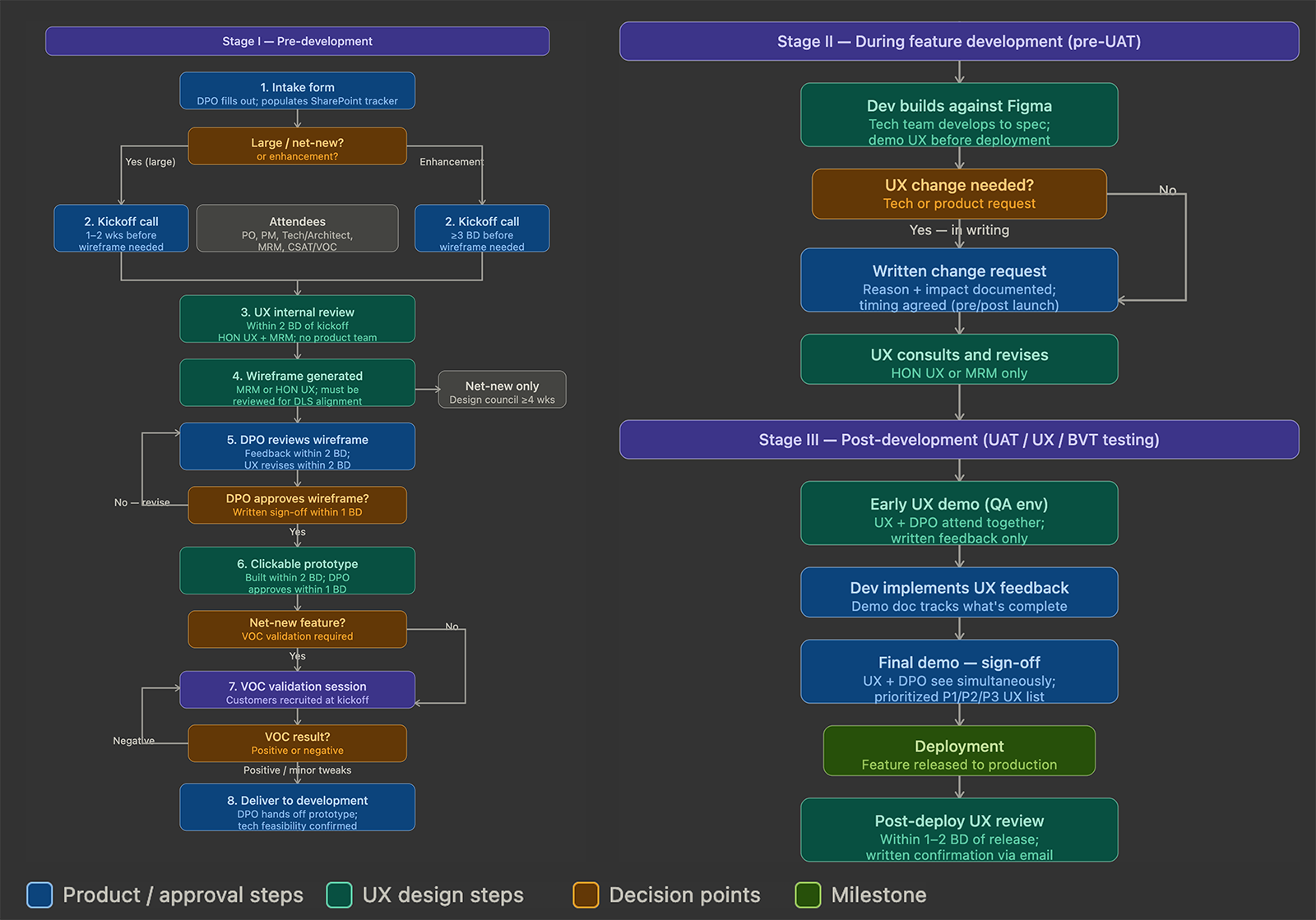
The Strategic Entry Point
Before building anything, I needed to understand where the existing system was breaking down. The answer wasn't hard to find: work was starting without enough information, and no one had a clear picture of who owned what or when to get involved. The gaps weren't a people problem — they were a structure problem. My entry point was deliberately narrow. Rather than attempting to overhaul everything at once, I identified the three moments that had the highest leverage: how work gets initiated, how it gets framed, and how the right people get aligned before a single pixel is touched. This led to the introduction of three foundational concepts that BA had never formally used — an intake form, a creative brief, and a kickoff meeting. Simple in theory, but transformative in practice. The intake form created a single source of truth for incoming work. The creative brief forced clarity on objectives, constraints, and success criteria before design began. The kickoff meeting brought product, technology, and design into the same room at the start — establishing shared context and surfacing misalignments early, when they were still cheap to resolve.
The Architecture
With the entry points established, the next challenge was building the connective tissue — a repeatable system that could move work from idea to delivery without losing fidelity or momentum along the way. I designed the process around five phases: intake, triage, execution, delivery, and iteration. Intake captures the request and populates a centralized tracker, ensuring nothing enters the system informally. Triage determines scope, complexity, and resourcing — critically, it's also where the decision is made whether to engage an external agency or execute internally, a distinction that had previously been made arbitrarily. Execution follows the established UX workflow: research, wireframing, review cycles, and prototype sign-off, with clearly defined responsibilities for internal team members and agency partners at each step. Delivery closes the loop with the development team through structured handoffs and post-launch review. And iteration ensures that what's learned after release feeds back into the next cycle, rather than evaporating. The result is a system where internal capability and external partnership aren't in tension — they're coordinated, with each playing a defined role within a process that the organization actually owns.
Adoption
Introducing process into an organization that has operated without it is as much a change management challenge as a design one. The resistance I encountered wasn't opposition — it was inertia. Teams had built informal workarounds that felt efficient in the moment, even when they were creating downstream problems. My approach was to make the new process easier than the old habits, not harder. I started by working closely with the product owners and project managers who were most directly affected, treating them as collaborators in refining the intake and kickoff structures rather than recipients of a mandate handed down from design. I was deliberate about showing early wins — cases where the process caught a misalignment before it became a rework cycle, or where a structured brief led to a faster, cleaner design outcome. For the agencies, integration required a different conversation: establishing clear expectations around DLS standards, review touchpoints, and sign-off protocols so that external output felt like a natural extension of internal work rather than a separate track running in parallel. Adoption didn't happen all at once, but it built steadily because the process was designed to reduce friction for the people using it, not just to satisfy an organizational chart.
Outcome
The most significant outcome isn't a metric — it's organizational. BA now has a UX practice that it owns. Work enters through a defined channel, gets evaluated against consistent criteria, and moves through a process that everyone involved understands. The agencies are integrated rather than siloed, operating within a framework that preserves their creative contribution while ensuring alignment with internal standards. Internally, the team has grown from one person to a functioning discipline with the structure to continue scaling. Qualitatively, the shift in how design work is discussed across the organization is notable — product and technology teams now initiate conversations about UX earlier, because the process has made it clear what that engagement looks like and why it matters. The work ahead is iteration: refining the process based on what the first cycles have revealed, deepening the feedback loops, and continuing to build the organizational fluency that turns a new process into an embedded culture.